12 Week Social Media Calendar
UGX 600,000A detailed plan of what to post on your social media channels for the next three months. This includes content themes, post captions, and suggested imagery. A structured calendar ensures…
+256787568587
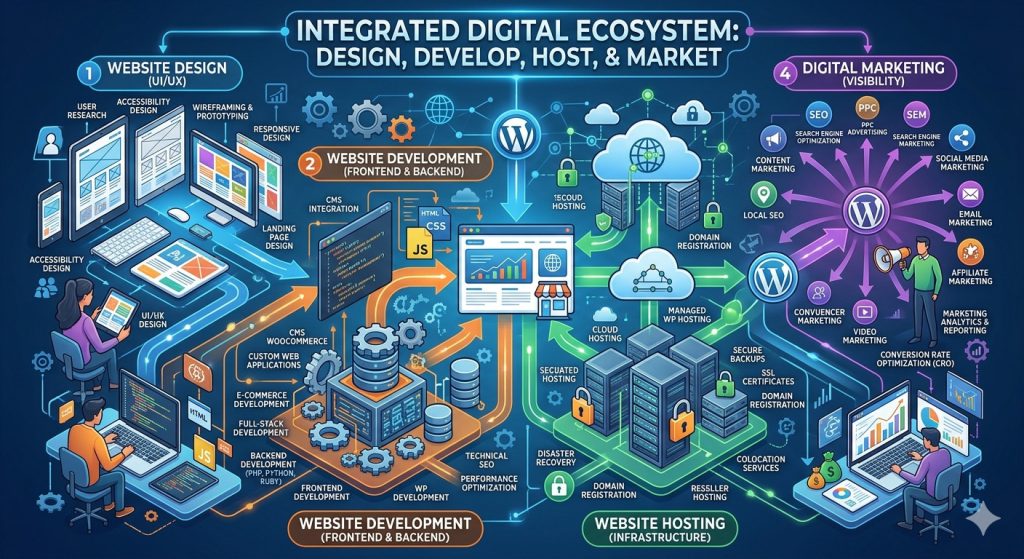
Comprehensive Insights & Frequently Asked Questions on Website Design, Development, Hosting, and Digital Marketing Strategy
Navigating the modern web ecosystem requires a multi-faceted alignment of creative vision, structural code, scalable cloud architecture, and data-driven marketing. This comprehensive guide synthesizes the 48 critical components of digital success into actionable intelligence for developers, designers, product managers, and entrepreneurs.
Pillar 1: Website Design & Experience Architecture
1. What is the fundamental difference between UI and UX design, and how do they interact?
User Interface (UI) design focuses on the cosmetic layout and tangible elements of a digital product—including visual design assets, interactive animations, typography selection, and layout systems. User Experience (UX) design governs the entire psychological journey, optimizing the functional ease, intuitive user pathways, structural informational hierarchy, and behavioral triggers of an application. UI is how a product looks; UX is how it behaves and fulfills intent. Tags: UI/UX Design
2. How do wireframing and prototyping mitigate development risks?
Wireframing acts as a low-fidelity visual blueprint, delineating content zones, functional modules, and navigation maps without the distraction of aesthetic elements. Prototyping translates these static schemas into mid-to-high-fidelity interactive simulations. Together, they allow stakeholders to uncover logical friction points, validate user flow loops, and iterate functional states before initiating any frontend engineering, drastically cutting technical debt and structural code modifications later. Tags: Wireframing, Prototyping
3. What engineering mechanics drive modern responsive design across diverse viewport constraints?
Responsive design ensures structural layout fluidly adapts across various displays. This is governed by fluid grid architectures, flexible vectors, and CSS media queries. Rather than building distinct mobile and desktop platforms, responsive architecture utilizes percentage-based scaling and break-point thresholds to dynamicize viewports, reducing asset overhead while ensuring functional and aesthetic consistency across modern phones, tablets, and massive ultrawide monitors. Tags: Responsive Design
4. What design principles dictate high-converting landing page design?
Landing page design isolates a singular conversion action by removing structural distraction. Key requirements include: an above-the-fold value proposition, clean directional cues pointing to a Call to Action (CTA), trust signals (testimonials, enterprise security badges), and a radical elimination of standard navigation elements. The interface layout is explicitly optimized to guide visual scanning behavior straight to the conversion goal. Tags: Landing Page Design
5. How do graphic design, branding, identity, and logo design intersect to form enterprise equity?
Graphic design is the execution tool used to build individual visual media. Logo design creates the foundational, easily recognizable emblem of an organization. Branding and identity integrate these visual assets with corporate messaging, culture, values, and guidelines to form a comprehensive design language system. This integrated visual system drives instant cross-channel recognition and customer loyalty across every digital touchpoint. Tags: Graphic Design, Branding and Identity, Logo Design
6. What structural strategies govern professional typography selection and color palette development?
Typography selection requires careful pairing of typefaces to establish an intuitive visual hierarchy, prioritizing legibility, responsive scales, and rendering performance across browsers. Color palette development uses behavioral psychology and strict contrast ratios to establish mood and highlight core UI interactions. Designers use established color theory models and structural font weights to ensure critical interactive components stand out immediately. Tags: Typography Selection, Color Palette Development
7. Why is user research critical, and how does accessibility design integrate into it?
User research replaces assumptions with objective user behavioral data collected via qualitative interviews, quantitative surveys, and usability testing metrics. Accessibility design builds directly onto these insights, ensuring interfaces comply with international Web Content Accessibility Guidelines (WCAG). This requires supporting screen reader navigation, designing high-contrast interfaces, and building semantic HTML layouts that allow users of all physical abilities to navigate a web application seamlessly. Tags: User Research, Accessibility Design
Pillar 2: Website Development & Full-Stack Systems Engineering
8. What parameters separate frontend, backend, and full-stack development roles?
Frontend development engineers everything users interact with in the browser, writing semantic client-side code using HTML, CSS, JavaScript, and frameworks like React or Vue. Backend development builds the server-side architecture, managing application business logic, custom content delivery, data flow processing, and secure system endpoints using technologies like Node.js, Python, or Go. Full-stack development spans both realms, handling the entire end-to-end stack from raw user interaction to database engineering. Tags: Frontend Development, Backend Development, Full-Stack Development
9. When should an enterprise leverage WordPress development and WooCommerce integration vs. custom web applications?
WordPress development combined with WooCommerce integration provides a robust, highly extensible Content Management System (CMS) environment, ideal for fast deployment and standard content or e-commerce workflows. However, for specialized business workflows, multi-tenant Software as a Service (SaaS) products, or complex computing needs, building a custom web application from scratch using tailored application frameworks offers far better architectural scaling, deep optimization, and complete layout control. Tags: WordPress Development, WooCommerce Integration, E-commerce Development, Custom Web Applications, CMS Integration
10. What role do API development and database architecture play in modern web applications?
Database architecture dictates how application data is modeled, organized, and retrieved using relational systems (such as PostgreSQL) or non-relational document stores (such as MongoDB). API development provides secure, organized messaging pathways (RESTful or GraphQL protocols) that allow the frontend layer, external microservices, and internal databases to exchange structural data efficiently and securely. Tags: API Development, Database Architecture
11. What structural principles drive Software as a Service (SaaS) development architectures?
SaaS development requires a multi-tenant software architecture where a single core application deployment serves numerous distinct customer accounts (tenants). This requires robust data isolation frameworks, programmatic billing engine integrations, global permission engines, and automated horizontal scaling strategies to ensure high uptime and security as tenant demand grows. Tags: Software as a Service (SaaS) Development
12. What is technical SEO implementation and performance optimization, and why are they vital?
Technical SEO implementation builds clean server configurations, accurate sitemaps, and semantic structured data so search engine bots can easily index an application. Performance optimization focuses on page rendering speeds by minifying source assets, applying modern caching strategies, compressing media formats, and reducing script runtime. This directly maximizes core web metrics, enhancing search ranking visibility and user conversion rates. Tags: Technical SEO Implementation, Performance Optimization
13. How does systematic QA and testing impact software delivery loops?
Quality Assurance (QA) and testing prevent software bugs from hitting live production platforms. It uses automated pipelines to run unit testing, end-to-end integration flows, browser compatibility checks, and load simulations. Catching functional errors early in code repositories prevents production regressions and ensures a secure, dependable application experience for end users. Tags: QA and Testing
Pillar 3: Website Hosting & Enterprise Infrastructure
14. What are the key distinctions between Shared, VPS, Dedicated, and Cloud hosting architectures?
Shared hosting aggregates hundreds of websites onto a single server infrastructure, sharing CPU and RAM, making it economical but vulnerable to traffic noise from neighboring sites. Virtual Private Server (VPS) hosting uses hypervisor software to slice a physical server into isolated virtual environments with dedicated system assets. Dedicated server hosting grants a client exclusive access to an entire physical hardware machine, maximizing compute power and data security.
Cloud hosting abstracts computing across a vast network of interconnected virtual servers, providing instant horizontal scaling, high availability, and consumption-based resource pricing. Tags: Shared Hosting, Virtual Private Server (VPS) Hosting, Dedicated Server Hosting, Cloud Hosting
15. What are the operational advantages of Managed WordPress hosting, Reseller hosting, and Colocation services?
Managed WordPress hosting delegates day-to-day server optimization, automated security patches, and site caching to hosting specialists, freeing developers to focus purely on code. Reseller hosting allows agencies to purchase bulk server space and re-package it as branded hosting solutions for clients. Colocation services let enterprise clients rent physical space within an industrial data center to house their own physical hardware, outsourcing power, cooling, and network infrastructure management. Tags: Managed WordPress Hosting, Reseller Hosting, Colocation Services
16. Why are Domain Registration and SSL Certificate Management critical web security steps?
Domain registration secures ownership of your digital address. SSL Certificate Management establishes encrypted Transport Layer Security (TLS) tunnels between the client’s web browser and the server. This encryption prevents bad actors from intercepting personal client data, protects the platform against cross-site scripting vulnerabilities, and satisfies mandatory web browser security protocols. Tags: Domain Registration, SSL Certificate Management
17. How do continuous server maintenance, backup services, and disaster recovery strategies prevent systemic data loss?
Server maintenance involves applying routine security updates and tuning performance configurations to prevent software vulnerabilities. Backup services maintain automated, isolated snapshots of database and application files. Disaster recovery strategies define exact systems procedures to restore live web operations immediately if a catastrophic infrastructure failure or cyberattack occurs. Tags: Server Maintenance, Backup Services, Disaster Recovery
18. What protocols define proactive network security monitoring?
Security monitoring uses continuous intrusion detection systems, web application firewalls (WAF), and real-time log analysis to identify malicious traffic patterns. Actively tracking network activity allows systems engineers to mitigate Distributed Denial of Service (DDoS) attacks and patch potential exploits before they disrupt business operations. Tags: Security Monitoring
Pillar 4: Digital Marketing & Customer Acquisition Strategy
19. What functional dynamics separate organic Search Engine Optimization (SEO) from Local SEO?
Organic SEO focuses on ranking content for global search queries by optimizing site structure, high-value keywords, and backlink authority. Local SEO targets geographically specific search intent, optimizing local citation data, regional maps visibility, and location listings to capture local customer intent within a specific service radius. Tags: Search Engine Optimization (SEO), Local SEO
20. How do Search Engine Marketing (SEM) and Pay-Per-Click (PPC) advertising models generate immediate market visibility?
While organic search authority takes months to build, SEM and PPC campaigns bid on targeted transactional keywords to place ads directly at the top of search result pages instantly. Advertisers only incur a cost when a user clicks through to their targeted landing page, allowing precise budget control and immediate traffic generation. Tags: Search Engine Marketing (SEM), Pay-Per-Click (PPC) Advertising
21. What parameters separate social media marketing from social media management?
Social media management oversees organic brand presence, handling content scheduling, customer service engagement, and community building across networks. Social media marketing focuses on building paid targeted ad campaigns, using demographic and behavioral data to reach specific new audiences and drive customer acquisitions. Tags: Social Media Marketing, Social Media Management
22. How do content marketing, email marketing, and video marketing work together to nurture leads?
Content marketing builds brand authority by publishing informative resources like blogs or whitepapers. Video marketing packages this information into highly engaging, visual content. Email marketing then delivers these tailored content assets directly to subscriber inboxes based on their behavior, moving leads systematically through the acquisition funnel. Tags: Content Marketing, Email Marketing, Video Marketing
23. What separates affiliate marketing from influencer marketing strategies?
Affiliate marketing relies on a performance-based revenue split where publishers earn a set commission only when their unique tracking link drives a direct purchase. Influencer marketing pays content creators upfront to leverage their established audience and authority, building brand awareness and trust through sponsored product endorsements. Tags: Affiliate Marketing, Influencer Marketing
24. What is online reputation management (ORM), and why is it vital?
Online Reputation Management (ORM) actively monitors and influences how a brand is perceived online. It involves tracking reviews, addressing public customer complaints constructively, and highlighting positive press. Proactively managing your brand’s digital footprint ensures a positive reputation that protects conversion rates across channels. Tags: Online Reputation Management
25. How do conversion rate optimization (CRO) and marketing analytics and reporting maximize marketing efficiency?
Marketing analytics and reporting track user behavior to show exactly where marketing spend delivers the best returns. Conversion Rate Optimization (CRO) uses this data to run quantitative A/B testing on site elements—like testing button placement or copy tweaks. This continuous testing maximizes the value of existing traffic by increasing the percentage of active buyers.
The conversion rate formula is calculated as:
CR = (Total Conversions / Total Unique Visitors) * 100% Tags: Conversion Rate Optimization (CRO), Marketing Analytics and Reporting
26. What defines growth hacking strategies in digital ecosystems?
Growth hacking focuses on fast, creative experimentation across product features and marketing channels to uncover scalable acquisition loops. Rather than relying solely on traditional paid ad budgets, it designs viral product loops, referral programs, and automated automation to drive rapid, low-cost user acquisition. Tags: Growth Hacking
Showing 1–16 of 107 results
A detailed plan of what to post on your social media channels for the next three months. This includes content themes, post captions, and suggested imagery. A structured calendar ensures…
Writing persuasive text for your search, social, and display ads. High quality ad copy is essential for attracting clicks and driving users toward your landing pages. We focus on clear…
Creation of custom visual elements including icons, banners, and illustrative assets tailored for digital use. This service ensures that your website has unique imagery that aligns with your brand message….
A comprehensive approach to improving your website’s visibility in search engine results. This includes keyword research, on page optimization, and link building strategies. Our goal is to drive high quality…
Creating a system where third party partners can promote your products in exchange for a commission on sales. This allows you to expand your reach significantly without upfront advertising costs….
Creating custom APIs to allow different software systems to communicate with each other. Whether you need to sync your website with an ERP or integrate third party services like maps…
Daily or weekly backups of your website files and databases stored in a secure, offsite location. In the event of a technical failure or security breach, we can quickly restore…
Defining the personality and tone of your brand’s communications. Whether you want to be seen as professional and authoritative or friendly and accessible, a consistent brand voice helps you connect…
A deep dive into the search engine strategies of your main competitors. We identify their top ranking keywords, backlink profiles, and content strategies, providing you with a roadmap to outrank…
Developing and distributing valuable, relevant, and consistent content to attract and retain a clearly defined audience. This includes blog posts, white papers, and infographics that establish your brand as an…
Updating and improving older blog posts and pages on your website to ensure they remain relevant and continue to rank well in search results. This is a cost effective way…
Real time monitoring of your website and server for potential threats, malware, and unauthorized access attempts. We use advanced firewalls and scanning tools to protect your data. If a threat…
Analyzing user behavior on your website to identify barriers to conversion and implementing changes to increase the percentage of visitors who take action. This involves A/B testing, heat mapping, and…
Development of a comprehensive visual identity that defines how your business is perceived in the market. This includes the creation of brand guidelines that dictate logo usage, imagery styles, and…
Connecting your website with Customer Relationship Management software like Salesforce or HubSpot. This ensures that every lead captured on your site is automatically synced with your sales team’s pipeline, improving…
Creating a helpful and on brand error page for when users visit a non-existent link. A well designed 404 page helps keep users on your site by providing links back…